/prod01/channel_122/lib/media/fit-website/site-assets/images/FT-Horiz_crimson-gold.png)
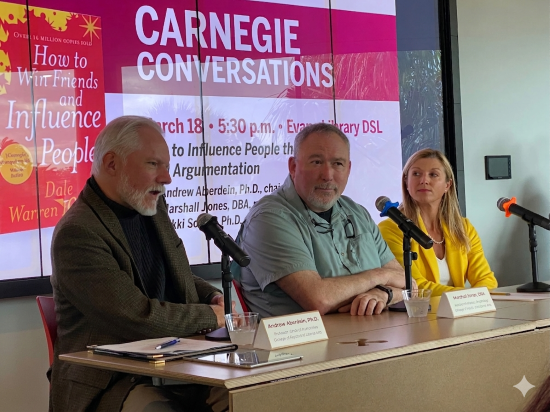
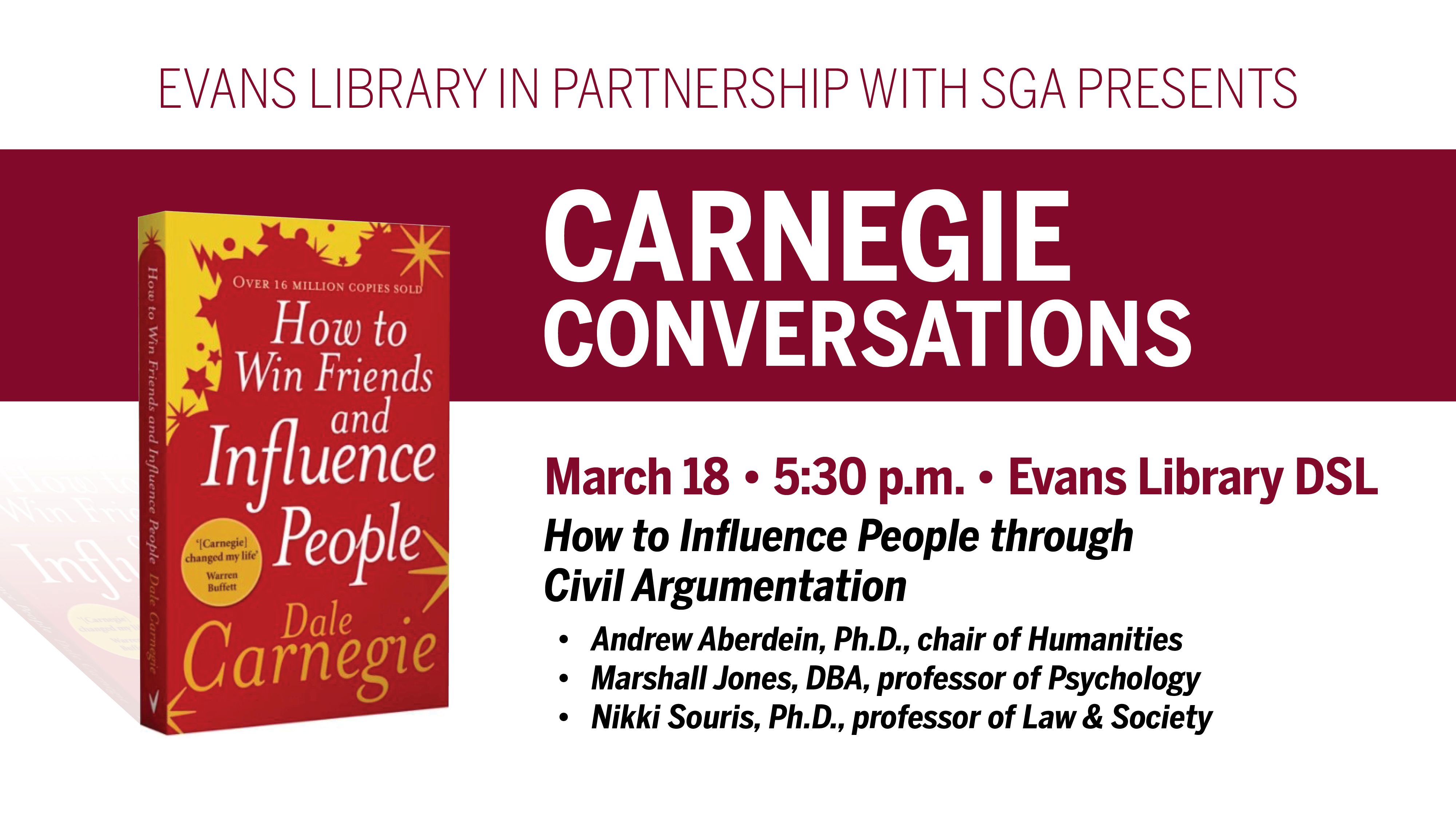
On Wednesday 18 March, the Evans Library held its second of two programs on Dale Carnegie's classic book How to Win Friends and Influence People. You can read about our first program Communicating to Win here. The library partnered with SGA who purchased over 100 copies of the book to distribute to Florida Tech students, who took them all in only a few days. In addition, the Evans Library organized two panel discussions on the book's principles. The second of which How to Influence People through Civil Argumentation featured Dr. Andrew Aberdein, Professor of Philosophy and Chair of Humanities Programs at Florida Tech; Dr. Marshall Jones, former law enforcement officer and Director of the Center for Applied Criminal Case Analysis at Florida Tech; and Dr. Nikki Souris Associate Professor of Law & Society and Pre-Law Advisor in the School of Arts & Communications. The panel discussed using Carnegie's principles to engage in civil discourse with others, especially those with whom we disagree.
The first issue the panel had to tackle was how did our society become so polarized in the first place. This is not a question with an easy answer. As the panelists explained, students today have never lived in a non-polarized time. The kind of uncivil, polarizing discourse in which they engage is what has always been modeled for them. Politicians and those who seek our time and attention, often engage in over-the-top rhetoric and divide-and-conquer tactics, making the "other side" out to be first-rate villains. As a result, this generation of students sees your arguments and where you stand on issues as a demonstration of your moral character.
Further, too many people out there want to tell us what our opinions should be, and we are often too cognitively lazy to figure out what we think.
Today's students seem to have difficulty having difficult conversations with others because they lack resiliency. One way of developing resiliency is receiving feedback you do not want to hear. Too many members of Gen Z grew up in school and sports environments where everyone receives participation trophies and no real hard teaching or coaching happens. Not only does hard teaching and coaching help students achieve excellence, but they also let students experience and take part in difficult discussions.
Finally, no discussion of civil discourse is complete with addressing the Internet and social media. The Internet has allowed people to discover and develop esoteric identities and find community within chat rooms and forums, leading to real life social fragmentation. Since online discourse does not involve face-to-face communication, it therefore lacks empathy. This causes the argument to become heated and extreme quickly. And whatever we participate in online, the algorithm will keep feeding us more and more of it.
So how do we move beyond this polarization and engage in civil discourse? First and foremost we need to see other people as human beings who have feelings and emotions just like us. We should be curious about and non-judgmental towards other people. Finally, we need to develop friendships for the sake of friendships, which is becoming a lost art in our society.